




Greater Iran – Items
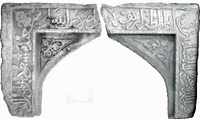
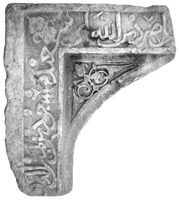
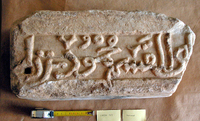
Arch, Ghazni, 1059-1099, Epigraphic Round Script
-
-
-
Cite
APA
Viola Allegranzi, ., & Martina Massullo, . (n.d.). Arch, Ghazni, 1059-1099, Epigraphic Round Script (1–), CallFront, accessed October 24, 2026, https://callfront.inha.fr/s/callfront/item/3820
Chicago
Viola Allegranzi, and Martina Massullo. n.d. “Arch, Ghazni, 1059-1099, Epigraphic Round Script.”, CallFront, accessed October 24, 2026, https://callfront.inha.fr/s/callfront/item/3820
MLA
Viola Allegranzi, and Martina Massullo. Arch, Ghazni, 1059-1099, Epigraphic Round Script, CallFront, accessed October 24, 2026, https://callfront.inha.fr/s/callfront/item/3820
Item descriptor
- Copyrights Holder
- CallFront
- License
- CC BY-SA 4.0
- Entry ID
- Afghanistan_VA_MM_11
- Date
- 451 - 492 H.
- 1059 – 1099
- Localization Exactitude Degree
- Exact
- Place of Production
- Afghanistan, Ghazni
- Present Location
- Ghazni, warehouse (upper fragments); Kabul, National Museum of Afghanistan (left side fragment)
- Language
- Arabic
- Type of text
- Titulature
- Text Content
- ...مويد الدين مغيث المسلمين ابي المظفر ابراهيم بن \ ناصر دين الـله ابي سعيد مسعود بن يمين الدولة \ ... ابي القسم محمود بن ناصر
- Script
- Epigraphic Round Script
- Color of the Script
- no trace of color left
- Remarks (General Identification)
- The inscriptions contains part of the titulature and the family lineage of the Ghaznavid Sultan Ibrāhīm (r. 451-492 H./1059-1099).
- Type of Object
- architectural element\arch
- Writing Surface
- stone\type of stone\marble
- Shape (Epigraphy)
- band
- Size (of the object)
- 25 x 40 cm (left side fragment only)
- Layout (Epigraphy & Objects)
- One line running from bottom to top on the right side, horizontally on the upper side, from top to bottom on the left side. Only two sections on the upper portion and left side of the arch are preserved.
- Technique
- carved / bas-relief - flat relief
- Instrument
- chisel
- Remarks (Support)
- The two upper fragments composing the arch were found reused in various locations in the Ghazni area. The lower left fragment was later identified among the archaeological materials stored at the Kabul National Museum.
- Bibliography
- RCEA, VIII, n° 2874
- Flury, Samuel. “Le décor épigraphique des monuments de Ghazna.” Syria 6, no. 1 (1925): 61–90. Here p. 74-75
- Blair, Sheila S. The Monumental Inscriptions from Early Islamic Iran and Transoxiana. V. Studies in Islamic Art and Architecture. Supplements to Muqarnas. E. J. Brill, 1992. 182, n° 69-C
- Giunta Roberta, Les inscriptions de la ville de Gazni (Afghanistan), PhD thesis, Université Aix-Marseille I, 1999, 3 vols (unpublished). Here vol. I, p. 351-355, no. 3b
- Pinder-Wilson, Ralph. “Ghaznavid and Ghūrid Minarets.” Iran 39 (2001): 155-186. Here p. 162.
- Allegranzi, Viola. Aux sources de la poésie ghaznavide : Les Inscriptions Persanes de Ghazni, Afghanistan, XIe-XIIe Siècles. Volume Ier. Presses Sorbonne nouvelle, 2019. Here vol. 1, p. 138-139
- Giunta, Roberta, and Allegranzi, Viola. “Ghaznavid, Qarakhanid and Seljuq Monumental Inscriptions and the Development of Royal Propaganda: Towards an Epigraphic Corpus.” In The Seljuqs and Their Successors: Art, Culture and History, edited by Sheila R. Canby, Deniz Beyazit, and Martina Rugiadi. Edinburgh Studies in Islamic Art. Edinburgh University Press, 2020. 113-128. Here p. 120-121, fig. 8.2.
- Online publications: https://ghazni.bdus.cloud/islamic/finds/marble/arches/record/IG0033
- https://ghazni.bdus.cloud/islamic/finds/marble/arches/record/IG0003
- TEI, no. 6209
Script descriptor
See the lexicon
General Script Characteristics
- Shape
- rectangular
- Groups of Characters Baseline
- oblique
- Character Spacing
- regular spaces between characters
- Presence of Elongation
- rare
- Ligature
- Conventional - curvilinear
- Shading / Contrast
- medium contrast
Letter Morphology
- Point
- round dot
Ascenders
Descenders
- nūn sīn shīn sādḍād yā’ lām and qāf descenders
- wide deep bowl
denticles
- sīn shīn denticles
- rounded base denticles
counters
- fā' qāf wāw counters
- rounded head
- medial 'ain ghayn counters
- compact inverted triangle / open or closed eye
vocalization and diacritics
- sukūn vocalization and diacritics
- circle
Other
- additional characteristics
-
Characters elongated in the corners of the epigraphic frame; vegetal ornament are attached to them;
- Diacritical points are not systematically used;
- Additional sukūn used to balance the negative space.