




China – Items
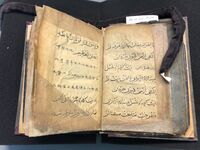
Manuscript, Xinjiang, c. 18-19th century, Naskhī
-
Cite
APA
Shunhua Jin, . (n.d.). Manuscript, Xinjiang, c. 18-19th century, Naskhī (1–), CallFront, accessed October 24, 2026, https://callfront.inha.fr/s/callfront/item/3861
Chicago
Shunhua Jin. n.d. “Manuscript, Xinjiang, c. 18-19th century, Naskhī.”, CallFront, accessed October 24, 2026, https://callfront.inha.fr/s/callfront/item/3861
MLA
Shunhua Jin. Manuscript, Xinjiang, C. 18-19th Century, Naskhī, CallFront, accessed October 24, 2026, https://callfront.inha.fr/s/callfront/item/3861
Item descriptor
- Copyrights Holder
- CallFront
- License
- CC BY-SA 4.0
- Entry ID
- China_SJ_08
- Author
- Shunhua Jin
- Contributor(s)
- Nuria Garcia Masip
- Date
- 1701 – 1900
- Localization Exactitude Degree
- Approximate
- Place of Production
- China, Xinjiang region
- Present Location
- Berlin State Library - Prussian Cultural Heritage
- Language
- Persian
- Title of the Document (If Relevant)
- Kitāb-i namāz
- Type of text
- Devotional text
- Text Content
- Fragment of a prayer book, without beginning and end, containing prayer templates in Inchinese sish (preface etc.), Arabic prayer texts, citations of passages from the hadith about the prayers in question, finally the fragment of a Persian prayer in verse, called Barāt-nāma, for Lailat al-Barāt. Individual leaves are missing.
- Script
- Naskhī/naskh
- Color of the Script
- black
- Remarks (General Identification)
- Ms. Or. Oct. 1580
- Type of Object
- manuscript\codex
- Writing Surface
- paper\type of paper\oriental paper
- Technique
- written
- Remarks (Support)
- 117 f. ; black cloth binding
Script descriptor
See the lexicon
General Script Characteristics
- Line of Writing
- ascending
- Groups of Characters Baseline
- Groups of characters baseline - horizontal
- Character Spacing
- irregular spaces between words
- Presence of Elongation
- occasional
- Shading / Contrast
- medium contrast
Letter Morphology
- Point
- inclined square
Ascenders
Descenders
- wāw descenders
- wāw - long flattened tapered tail, hairline ending
- rā' zā' descenders
- rā'/zā' - long flattened tapered tail, hairline ending
- rā'/zā' - short curvilinear tail
- rā'/zā' - s-shaped
- nūn sīn shīn sādḍād yā’ lām and qāf descenders
- nūn, sīn/shīn, sād/ḍād, yā', lām, qāf - curvilinear flattened bowl
- nūn, sīn/shīn, sād/ḍād, yā', lām, qāf - elongated curvilinear flattened bowl
horizontals
- bāʾ tāʾ thāʾ fāʾ kāf horizontals
- bāʾ, tāʾ, thāʾ, fāʾ, kāf - curvilinear flattened bowl
denticles
- sīn shīn denticles
- short pointed denticles
- initial and medial bāʾ tāʾthāʾ nūn yāʾ denticles
- initial slightly inclined to left
- medial short rounded denticles
counters
- hā' counters
- isolated one-eyed triangular (murabba'ah)
- initial / medial double eyed (wajh al-hirr)
- final simple downward stroke (makhṭufah)
- final one-eyed (mardufah) with elongated vertical shaft
- fā' qāf wāw counters
- soft triangular head
- medial 'ain ghayn counters
- wide inverted triangle
- mīm counters
- rounded head pointed chin
vocalization and diacritics
- fatḥa kasra vocalization and diacritics
-
oblique stroke
(10°-35°) - ḍamma vocalization and diacritics
- comma
- sukūn vocalization and diacritics
- circle
- shadda vocalization and diacritics
- short denticles