




South Asia – Items
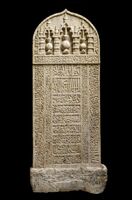
Tombstone, Khambhat, 1311, Ta’līq and other
-
Cite
APA
Elizabeth Lambourn, . (n.d.). Tombstone, Khambhat, 1311, Ta’līq and other (1–), CallFront, accessed October 24, 2026, https://callfront.inha.fr/s/callfront/item/3901
Chicago
Elizabeth Lambourn. n.d. “Tombstone, Khambhat, 1311, Ta’līq and other.”, CallFront, accessed October 24, 2026, https://callfront.inha.fr/s/callfront/item/3901
MLA
Elizabeth Lambourn. Tombstone, Khambhat, 1311, Ta’līq and Other, CallFront, accessed October 24, 2026, https://callfront.inha.fr/s/callfront/item/3901
Item descriptor
- Copyrights Holder
- CallFront
- License
- CC BY-SA 4.0
- Entry ID
- India_EL_04
- Author
- Elizabeth Lambourn
- Contributor(s)
- Nuria Garcia Masip
- Date
- 20 Muharram 711 H.
- June 8, 1311
- Localization Exactitude Degree
- Exact
- Place of Production
- India, Gujarat State, Khambhat
- Remarks (Place of Production)
- Tombstone of marble, carved in Khambhat, Gujarat, circa 1300-10 and shipped to Dhofar, now in Oman, where the epitaph was added
- Present Location
- Victoria and Albert Museum London, accession no. A12 1933
- Language
- Arabic
- Type of text
- Quran
- Nature of the Text
- Bismillah
- Shahada
- Reference for Quranic verses
- Text Content
-
Recto (with epitaph): surah Hā Mīm (XLI, 30-35 incomplete); surah al-Mulk (LXVII, 1-5 incomplete). Epitaph: intqala mawlāna sultān al-islām al-malik/al-wāthiq nūr al-dīn ibrāhīm ibn al-malik al-/ muzaffar ilá rahmat/allāh yawn al-arbi'ā' al-'ashrīn min al-muharram, sana ihdá/'ashar wa sab'imi'ah sllá allāh 'alá muhammad wa ālihi wa ashābihi.
Verso: the Throne Verse (II, 255) and continues to يخرجهم من الظلمات in verse 257; surah al-Ḥashr (LIX) from the beginning of verse 21 to الأسماء الحسنى in verse 24; surah Āl ‘Imrān (III, 18-19, to إنّ الدين عند الله الإسلام, and 26-7); al-Tawbah (IX, 21-22); al-Zumar (XXXIX, 73-74, to حيث نشاء: - Remarks (General Identification)
-
For high quality photos and conservation discussion see https://www.vam.ac.uk/blog/caring-for-our-collections/preparation-of-three-14the-century-gravestones-for-a-display-at-the-national-museum-of-oman
Example of finished tombstone exported and recarved in situ in Dhofar. Script and carving style of epitaph and central Qur’anic panel on other stone are completely different to rest of stones.
In its altered form it was used with another, similar tombstone (V&A: A.13-1933) to mark the grave of the Rasulid governor of Dhofar, al-Malik al-Wathiq Nur al-Din Ibrahim.
Triple lamp motif on side of one stone recalls tombstones in situ in Cambay dated 1337 (Desai 1971, insc. X) and 1330 (Desai 1971, insc. XIII) indicating that these stones may have been brought to Dhofar to commemorate al-Wathiq’s grave two decades or more after his death.
Records death of al-Malik al-Wāthiq Nūr al-Dīn Ibrahīm ibn al-Mlaik al-Muzaffar, son of the Rasulid Sultan and governor of Dhofar - Type of Object
- cenotaph/tombstone
- Writing Surface
- stone\type of stone\marble
- Size (of the object)
- 128 x 55 x 9 cm
- Layout (Epigraphy & Objects)
- 9 lines of different heights with inscribed borders
- Technique
- carved / bas-relief - flat relief
- Instrument
- chisel
- Bibliography
- Guest, R. “Zufar in the Middle Ages.” In Islamic Culture. 1935. Plates A1 and A-2.
- Porter, V. “The Art of the Rasulids.” In 3,000 Years of Art and Civlization in Arabia Felix. Innsbruck/Frankfurt, 1987. 235 and 252, catalogue nos. 52-3, plates on p. 249, 250.
- Porter, V. “Three Rasulid Tombstones from Zafar.” In Journal of the Royal Asiatic Society. 1988. 32-37, Plate 1 A and B, 2 A and B.
- Lambourn, E. “Carving and Recarving: Three Rasulid Gravestones Revisited.” In New Arabian Studies, G. Rex Smith, J.R. Smart and B.R. Pridham, vol. 6. 2003. 18-25, Plates 1 and 2.
Script descriptor
See the lexicon
General Script Characteristics
- Presence of Elongation
- rare
- Length of Elongation
- varied length of elongations
- Ligature
- Conventional - curvilinear
- Shading / Contrast
- medium contrast
Letter Morphology
- Point
- inclined square
Ascenders
- Alif Ascenders
- alif - shaft tapers from thick to thin
Descenders
- wāw descenders
- wāw - rounded tail
- rā' zā' descenders
- rā'/zā' - s-shaped
- mīm descenders
- mīm - s-shape
- nūn sīn shīn sādḍād yā’ lām and qāf descenders
- nūn, sīn/shīn, sād/ḍād, yā', lām, qāf - plunging bowl
- yā’ al-rāji’ah descenders
- backward oblique stroke
horizontals
- bāʾ tāʾ thāʾ fāʾ kāf horizontals
- bāʾ, tāʾ, thāʾ, fāʾ, kāf - curvilinear flattened bowl
- bāʾ, tāʾ, thāʾ, fāʾ, kāf - deep plunging bowl
denticles
- sīn shīn denticles
- short pointed denticles
- initial and medial bāʾ tāʾthāʾ nūn yāʾ denticles
- initial slightly inclined to left
counters
- hā' counters
- initial / medial double eyed (wajh al-hirr)
- final s-shaped (muḥdawdibah)
- isolated one-eyed triangular (murabba'ah)
- fā' qāf wāw counters
- rounded head
- medial 'ain ghayn counters
- compact inverted triangle
- mīm counters
- circular head
vocalization and diacritics
- fatḥa kasra vocalization and diacritics
- horizontal stroke
- shadda vocalization and diacritics
- tall denticles
Other
- additional characteristics
- Spider-like quality from stacked thin tails and bowl endings