




South Asia – Items
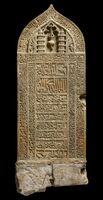
Tombstone, Khambhat, 1311, Ta’līq and other
-
Cite
APA
Elizabeth Lambourn, . (n.d.). Tombstone, Khambhat, 1311, Ta’līq and other (1–), CallFront, accessed October 24, 2026, https://callfront.inha.fr/s/callfront/item/3902
Chicago
Elizabeth Lambourn. n.d. “Tombstone, Khambhat, 1311, Ta’līq and other.”, CallFront, accessed October 24, 2026, https://callfront.inha.fr/s/callfront/item/3902
MLA
Elizabeth Lambourn. Tombstone, Khambhat, 1311, Ta’līq and Other, CallFront, accessed October 24, 2026, https://callfront.inha.fr/s/callfront/item/3902
Item descriptor
- Copyrights Holder
- CallFront
- License
- CC BY-SA 4.0
- Entry ID
- India_EL_05
- Author
- Elizabeth Lambourn
- Contributor(s)
- Nuria Garcia Masip
- Date
- 20 Muharram 711 H.
- June 8, 1311
- Localization Exactitude Degree
- Exact
- Place of Production
- India, Gujarat State, Khambhat
- Remarks (Place of Production)
- Tombstone of marble, carved in Khambhat, Gujarat, circa 1300-10 and shipped to Dhofar, now in Oman, where central panel (ssurah al-Fatiha (I, 2-7) was carved circa 1311.
- Present Location
- Victoria and Albert Museum London, accession no. A13 1933
- Language
- Arabic
- Type of text
- Quran
- Nature of the Text
- Reference for Quranic verses
- Bismillah
- Shahada
- Text Content
-
Recto: surah al-Mulk (II, 255 to 257 to من الظلمات الى نوره); surah Āl 'Imrān (III, 18-19 to ان الدين عند الله الاسلام ; surah Āl 'Imrān (III, 26-27 and 185); surah al-Tawbah (IX, 21-22), surah al-Mu'minūn (XXIII, 29); surah al-Zumar (XXXIX, 74, incomplete).
Verso: surah al-Mulk (II, 285 to 286); surah Fuṣṣilat (LXI, 21-24, to وجعلناها رجوماً للشياطين ; surah al-Fatiha (I, 2-7) - Remarks (General Identification)
-
In its altered form it was used with another, similar tombstone (V&A: A.12-1933) to mark the grave of the Rasulid governor of Dhofar, al-Malik al-Wathiq Nur al-Din Ibrahim. Four lines of epitaph in central panel carved in Dhofar after the death of al-Wathiq.
Four lines of central panel carrying al-Fatiha (I, 2-7) carved in Dhofar. - Type of Object
- cenotaph/tombstone
- Writing Surface
- stone\type of stone\marble
- Size (of the object)
- 127 x 48 x 9.5 cm
- Layout (Epigraphy & Objects)
- 9 lines of different heights with inscribed borders
- Technique
- carved / bas-relief - flat relief
- Instrument
- chisel
- Bibliography
- Guest, R. “Zufar in the Middle Ages.” In Islamic Culture. 1935. 403-4, illustrated as pls (B-1) and (B-2).
- Smith, R., and V. Porter. “The Rasulids in Dhofar in the VIIth-VIIIth/XIIIth-XIVth Centuries.” Royal Asiatic Society of Great Britain and Ireland CXX, no. 1. 1988: 26–44. Especially Venetia Porter, 'Part II. Three Rasulid Tombstones from Ẓafār', pp. 32-44, illustrated as pls 1B and 2A.
- Porter, V. “The Art of the Rasulids.” In 3,000 Years of Art and Civlization in Arabia Felix. Innsbruck/Frankfurt, 1987. 249-50, no. 53.
- Lambourn, E. “Carving and Recarving: Three Rasulid Gravestones Revisited.” In New Arabian Studies, G. Rex Smith, J.R. Smart and B.R. Pridham, vol. 6. 2003. 10-29, pl.1 and 2..
- Lambourn, E. “Carving and Communities: Marble Carving for Muslim Communities at Khambhat and Around the Indian Ocean Rim (Late 13th–Mid-15th Centuries CE).” Ars Orientalis 34 (2004): 99–133.
- Guy, John. “Asian Trade and Exchange Before 1600.” In Encounters. The Meeting of Asia and Europe, 1500-1800, Anna Jackson and Amin Jaffer. V&A, 2004. 56-7, illustrated as fig. 6.7.
- Puisto, Johanna. “Preparation of Three 14th Century Gravestones for a Display at the National Museum of Oman.” V&A Blog, April 24, 2017.
Script descriptor
See the lexicon
General Script Characteristics
- Presence of Elongation
- rare
- Length of Elongation
- varied length of elongations
- Shading / Contrast
- medium contrast
Letter Morphology
Ascenders
- Alif Ascenders
- alif - shaft tapers from thick to thin
Descenders
- wāw descenders
- wāw - rounded tail
- rā' zā' descenders
- rā'/zā' - s-shaped
- nūn sīn shīn sādḍād yā’ lām and qāf descenders
- wide deep bowl
- nūn, sīn/shīn, sād/ḍād, yā', lām, qāf - plunging bowl
- elongated curvilinear deep bowl
- jīm ḥāʾ khā' and ‘ain ghayn descenders
- looped tail
- yā’ al-rāji’ah descenders
- backward oblique stroke
horizontals
denticles
- sīn shīn denticles
- rounded base denticles
- initial and medial bāʾ tāʾthāʾ nūn yāʾ denticles
- initial/medial slightly inclined to left
counters
- hā' counters
- initial / medial double eyed (wajh al-hirr)
- medial v-shape with bottom closed loop towards the right
- final one-eyed (mardufah) diamond shaped
- isolated one-eyed triangular (murabba'ah)
- fā' qāf wāw counters
- rounded head needle point eye
- medial 'ain ghayn counters
- compact inverted triangle
- mīm counters
- circular head
vocalization and diacritics
- shadda vocalization and diacritics
- tall denticles
Other
- additional characteristics
- Spider-like quality from stacked thin tails and bowl endings